

You may find it insightful to learn that the Yemen civil war has transformed from a simple internal conflict into a battleground where regional powers like Iran and Saudi Arabia vie for supremacy. This ongoing fighting is reshaping alliances, intensifying hostilities, and leading to a significant humanitarian crisis. The effects of this conflict extend well beyond Yemen’s borders, influencing global relations in unforeseen manners. How might this situation influence the pursuit of long-term peace in the Middle East and across the international community as a whole?
Key Takeaways
- The Yemeni Civil War, beginning in 2014, reveals deep-rooted tribal and ideological divides, complicating governance and peace efforts.
- External powers like Iran and Saudi Arabia engage in proxy warfare, exacerbating the conflict and influencing local alliances.
- The humanitarian crisis in Yemen has led to widespread famine, disease, and displacement, affecting millions and creating a refugee crisis.
- Economic disruptions from the war have resulted in high unemployment, inflation, and a decline in foreign investments, worsening living conditions.
- Effective conflict resolution requires a multi-faceted approach that integrates international mediation, community engagement, and transitional justice for lasting peace.
Overview of the Yemen Civil War
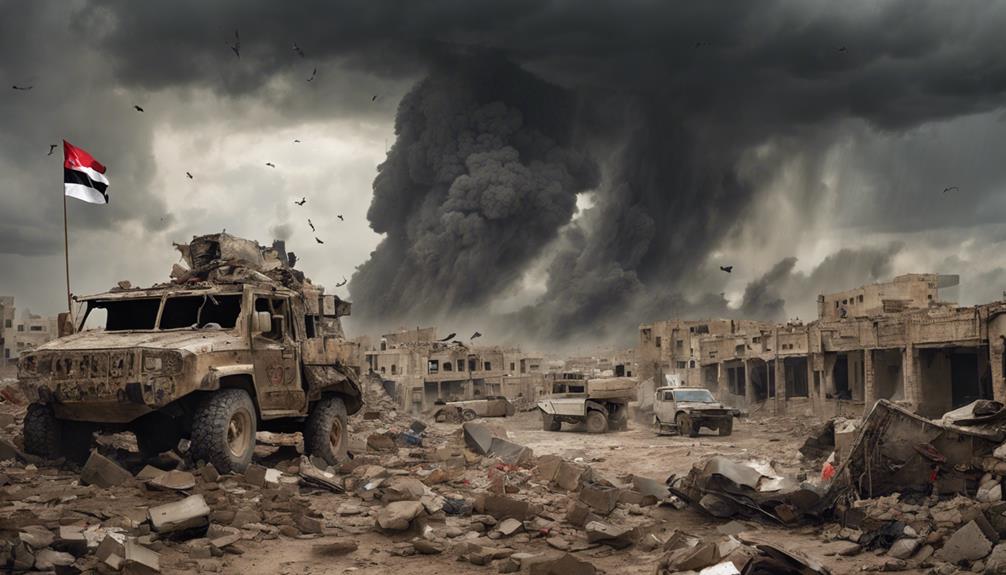
Yemen’s civil war is often marked by its complexity and multifaceted nature, emerging prominently around 2014 when Houthi rebels seized the capital, Sana’a. To understand this conflict, you need to take into account Yemen’s history, which is steeped in tribal affiliations, political fragmentation, and enduring regional rivalries. These elements shaped the current landscape, as various factions vie for control, often drawing upon cultural influences that span centuries.
The ongoing humanitarian crisis, exacerbated by the conflict, has led to widespread suffering and displacement among the population, including vulnerable groups like Yemeni Christians.
The Houthis, with their roots in the Zaidi sect of Shia Islam, represent a significant cultural and religious aspect of Yemen’s diverse identity. Their rise to power not only reflects internal grievances but also highlights historical tensions among different groups.
It’s important to acknowledge that the civil war isn’t merely a struggle for power; it symbolizes a clash of ideologies, traditions, and aspirations for governance.
As you analyze the situation, keep in mind that external actors also play a pivotal role, further complicating the conflict. The interplay of local and international influences creates a volatile environment, making it vital for you to grasp the historical context to fully understand the ongoing turmoil in Yemen.
Key Players Involved
Amidst the chaos of the civil war, several key players emerge, each with distinct motivations and influences that shape the conflict’s dynamics. The Houthis, utilizing strategic military tactics and local governance, seek to assert control over territory and resources, bolstering their war economy. Meanwhile, the Saudi-led coalition, driven by regional interests, navigates complex coalition dynamics and engages in international mediation efforts to stabilize the region while addressing Yemeni nationalism.
| Key Players | Influences |
|---|---|
| Houthis | Houthi strategies aimed at territorial control and local governance. |
| Saudi-led Coalition | Coalition dynamics influenced by regional power struggles and Yemeni nationalism. |
| International Bodies | Focused on human rights, the refugee crisis, and facilitating diplomatic efforts. |
Tribal alliances also play a significant role, impacting local governance and creating shifting loyalties. The ongoing conflict exacerbates the humanitarian crisis, prompting urgent calls for action from international bodies. As you analyze these key players, consider how their interactions contribute to the complexities of Yemen’s civil war and the broader geopolitical landscape.
Regional Power Struggles
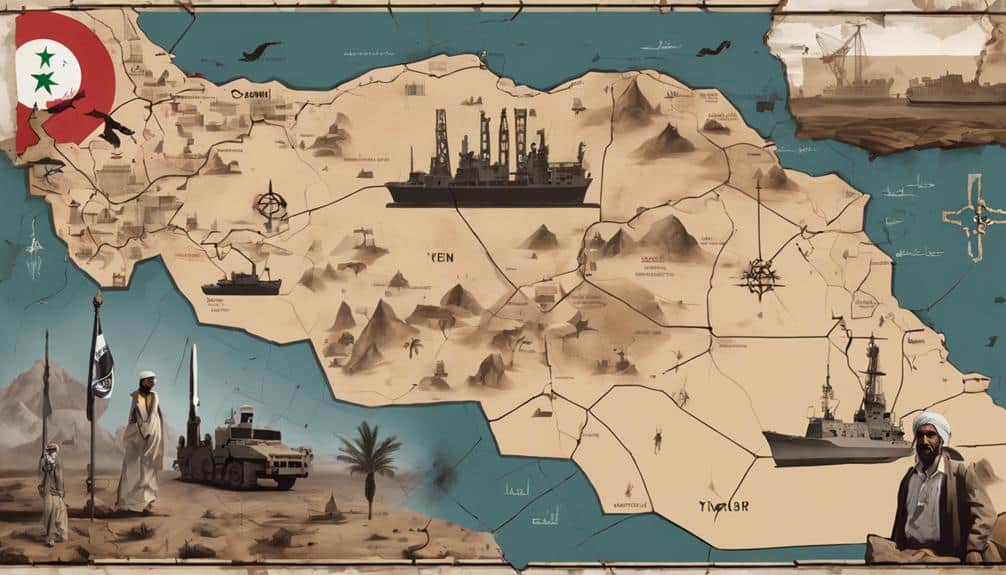
In Yemen’s civil war, regional power struggles substantially shape the conflict’s dynamics.
You’ll notice how Iran seeks to expand its influence by supporting the Houthi movement, while Saudi Arabia pursues its own ambitions to counteract Tehran’s reach.
This rivalry not only complicates the situation on the ground but also highlights the broader geopolitical implications of the war.
Iran’s Influence in Yemen
Many observers recognize Iran’s growing influence in Yemen as a crucial factor in the region’s power struggles. This influence manifests through various channels, primarily Houthi support, which Iran provides in the form of weapons, training, and ideological alignment. Such backing not only strengthens the Houthis but also fits neatly into Iran’s broader regional strategy of engaging in proxy warfare against its adversaries.
Iran’s involvement isn’t limited to military aid. It engages in diplomatic outreach to bolster its sectarian ties within Yemen, allowing it to exert soft power. Intelligence sharing between Iranian military officials and the Houthis enhances their operational capabilities, making the group a formidable player in the conflict.
Furthermore, Iran’s economic interests in the region are significant; by supporting the Houthis, Iran aims to secure access to essential maritime routes and resources. Humanitarian aid, though often viewed skeptically, is another tool in Iran’s arsenal. By providing assistance, Iran seeks to gain popular support among Yemenis, further entrenching its influence.
Consequently, Iran’s multifaceted approach underscores its strategic intent to reshape the balance of power in Yemen and the surrounding region.
Saudi Arabia’s Regional Ambitions
Saudi Arabia’s ambitions in Yemen reflect its desire to assert dominance in the region and counter Iran’s influence. As you analyze Saudi strategies, you’ll notice a clear focus on military interventions to reshape regional security dynamics. The Kingdom’s actions are often driven by economic interests, particularly concerning energy policies essential to its economy.
| Aspect | Saudi Arabia’s Approach | Impact on Region |
|---|---|---|
| Military Interventions | Leading a coalition against the Houthis | Strengthens Saudi political leverage over neighbors |
| Coalition Dynamics | Forming alliances with Gulf states | Alters the balance of power in the Arabian Peninsula |
| Historical Context | Addressing threats from past conflicts | Influences current diplomatic relations and security policies |
Through these strategies, Saudi Arabia seeks to enhance its regional standing and diminish Iranian footholds. The coalition dynamics illustrate how Riyadh utilizes partnerships to bolster its military and political position. Ultimately, the ongoing conflict in Yemen is not merely about territorial control; it’s a chess game of influence, where energy policies and historical context play significant roles in shaping the future of the region.
Humanitarian Crisis in Yemen
Facing a dire humanitarian crisis, Yemen struggles with widespread famine, disease, and displacement amid ongoing conflict. The situation is exacerbated by severe food insecurity, leaving millions without access to basic nutrition.
You’ll find that child malnutrition rates are alarming, with many young ones suffering long-term health challenges due to inadequate diets. In this scenario, the resilience of Yemeni women becomes even more significant, as they adapt to the challenges presented by the conflict and work to support their families and communities.
The international response has been inconsistent, often hampered by access barriers that prevent humanitarian aid from reaching those in need. Displacement issues add another layer of complexity, as countless families are forced to flee their homes, leading to a burgeoning refugee crisis.
Living conditions in makeshift shelters are dire, with inadequate sanitation and limited healthcare resources.
Moreover, the psychological trauma inflicted on the population can’t be overlooked. Survivors of violence and instability face ongoing mental health challenges, which further complicate recovery efforts.
As global awareness grows, the urgency for a thorough approach to alleviate Yemen’s suffering becomes critical. Without sustained commitment and action, the humanitarian crisis will deepen, affecting not only Yemen but also the broader region.
Impact on Saudi-Iran Relations

The ongoing humanitarian crisis in Yemen has intensified tensions between regional powers, particularly Saudi Arabia and Iran. This conflict serves as a battleground for proxy warfare, where each nation backs opposing factions, exacerbating sectarian tensions. As they vie for influence, both countries engage in diplomatic maneuvers aimed at securing their strategic interests in the region.
| Aspect | Saudi Arabia |
|---|---|
| Military Interventions | Support for the Yemeni government |
| Ideological Divides | Sunni Muslim leadership |
| Security Concerns | Protecting trade routes |
| Historical Grievances | Opposition to Iranian influence |
Iran, on the other hand, supports the Houthis, reflecting its aim to expand influence and challenge Saudi dominance. This ideological divide complicates regional stability, as both nations perceive each other as threats. Their military interventions in Yemen have further strained relations, leading to increased hostilities and deep-rooted grievances. Ultimately, the Yemen conflict highlights the broader geopolitical struggle between Saudi Arabia and Iran, with implications that extend beyond their borders and impact the security landscape of the entire region.
Influence of External Powers
While regional dynamics play an essential role in Yemen’s civil war, external powers greatly influence the conflict’s trajectory. You see, military interventions from countries like Saudi Arabia and the UAE have been pivotal, as they’ve aimed to counter Iran’s growing influence through their support for the Yemeni government.
This intervention isn’t just about military presence; it reflects broader geopolitical strategies that extend to energy resources, with Yemen’s strategic location affecting global oil supply routes.
Moreover, diplomatic negotiations often falter due to the competing interests of these external players, who leverage international sanctions and the arms trade to bolster their political alliances. For instance, arms supplied by various nations exacerbate the conflict and complicate humanitarian aid efforts, leaving countless civilians in dire need.
Security concerns also drive these powers to engage deeply in Yemen, viewing the conflict through the lens of ideological conflicts that stretch beyond its borders.
As you consider the complexity of these interactions, it’s clear that the influence of external powers shapes not only Yemen’s civil war but also the broader regional landscape, making resolution increasingly challenging.
Shifts in Alliances
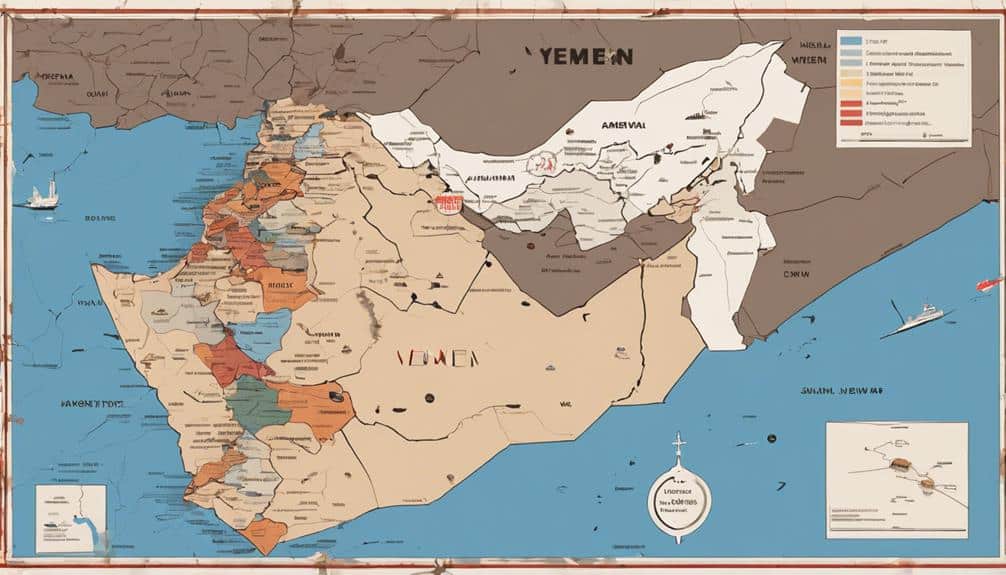
As you examine the shifts in alliances within Yemen’s civil war, you’ll notice how regional power dynamics play a vital role in determining allegiances.
External influences and interests further complicate these relationships, often leading to unexpected partnerships and rivalries.
Understanding these changes is essential for grasping the broader implications of the conflict on both regional stability and international relations.
Regional Power Dynamics
Shifts in alliances among regional powers have considerably influenced the trajectory of Yemen’s civil war. As these alliances evolve, they create a power vacuum that various stakeholders attempt to fill. Countries like Saudi Arabia and Iran have engaged in military interventions, each supporting different factions, which exacerbates sectarian tensions and complicates diplomatic negotiations.
| Regional Power | Role in Yemen’s Civil War |
|---|---|
| Saudi Arabia | Supports the Yemeni government; focuses on border security and countering Iranian influence. |
| Iran | Backs Houthi rebels; seeks to expand its regional influence and access to energy resources. |
| UAE | Engaged in military interventions; invests in southern Yemen for strategic and economic interests. |
| Oman | Maintains neutrality; engages in diplomatic negotiations to mediate peace efforts. |
These strategic alliances reflect broader geopolitical interests, including energy resources and foreign investments. The ongoing conflict not only shapes Yemen’s future but also the stability of the entire region. As alliances shift, the implications for border security and the delicate balance of power become increasingly complex, necessitating careful observation and analysis.
External Influences and Interests
In the complex landscape of Yemen’s civil war, external influences play a critical role in shaping the conflict’s dynamics and outcomes. Key players, including regional powers and global actors, engage in diplomatic negotiations that often reflect their own ideological conflicts and energy interests.
For instance, Saudi Arabia and Iran’s rivalry has intensified military interventions, with each backing different factions, complicating peace efforts.
Additionally, the arms trade has surged, as countries supply weapons to bolster their allies, further entrenching the conflict. Economic sanctions imposed on specific groups aim to weaken their influence, yet they often exacerbate humanitarian crises, leading to increased foreign aid requirements.
This aid can sometimes become a tool of leverage in diplomatic negotiations, as external powers seek to influence local governance structures.
Peacekeeping missions, while aimed at stabilizing the region, often struggle due to the fragmented nature of alliances and ongoing hostilities.
The shifting allegiances among local actors in response to external pressures highlight the complex interplay of foreign interests in Yemen’s civil war, revealing a landscape where geopolitical strategies greatly affect the prospects for lasting peace and stability.
Economic Consequences
The economic consequences of Yemen’s civil war are profound and multifaceted, impacting not just the local population but also regional stability. As you analyze the situation, you’ll notice several critical areas where the conflict has taken a toll:
1. Trade Disruptions: Ongoing hostilities have severely hampered trade routes, leading to shortages of essential goods. This disruption not only affects daily life but also escalates inflation rates, making commodities increasingly unaffordable.
The strategic location of Yemen along trade routes between Europe, Asia, and Africa, if leveraged, could enhance market accessibility and mitigate some of these trade disruptions, but the current conflict undermines this potential strategic location benefits.
2. Employment Challenges: With businesses shuttered and infrastructure damaged, unemployment has surged. Many find themselves in a cycle of poverty increase and aid dependency, relying on humanitarian assistance for survival.
The unemployment rate, which stands around 40%, further complicates the situation and highlights the need for economic recovery strategies.
3. Investment Decline: The uncertainty and violence have driven away foreign investments, exacerbating resource depletion and limiting economic growth.
Currency instability further complicates the situation, as inflation continues to erode purchasing power.
In this complex web of economic sanctions, employment challenges, and inflation, Yemen’s future remains precarious. The consequences extend well beyond its borders, with ripple effects felt throughout the region, challenging stability and security.
Prospects for Peace

Amidst the ongoing turmoil, evaluating the prospects for peace in Yemen reveals a complex landscape shaped by internal divisions and external influences. The path to conflict resolution is fraught with challenges, as entrenched factions often resist peace negotiations. Recent diplomatic initiatives have sought to broker ceasefire agreements, yet these efforts frequently falter due to lack of commitment from key players.
Additionally, the rich tapestry of Yemen’s cultural identity, including its traditional clothing and cultural identity, plays a significant role in fostering a sense of belonging that can unite communities. International mediation plays a significant role in facilitating dialogue, but it requires the active participation of all stakeholders. Grassroots movements and community engagement are essential for fostering trust and reconciliation efforts at the local level. These initiatives can empower citizens, allowing them to shape their own futures post-conflict.
Transitional justice will also be essential in addressing grievances and ensuring accountability. By acknowledging past atrocities, Yemen can pave the way for healing and unity. However, without a concerted effort toward post-war reconstruction, the prospects for lasting peace remain tenuous.
It’s clear that a multi-faceted approach, integrating both top-down and bottom-up strategies, is necessary to nurture an environment conducive to peace and stability. Only then can Yemen hope to emerge from the shadows of war.
Frequently Asked Questions
What Are the Historical Roots of Yemen’s Civil Conflict?
Yemen’s civil conflict stems from deep-rooted tribal dynamics and political fragmentation. You’ll see how historical grievances, regional rivalries, and governance failures have fueled divisions, leading to sustained violence and instability in the region.
How Has the Civil War Affected Yemen’s Cultural Heritage?
You’d think Yemen’s cultural heritage is impervious to destruction, but the civil war’s ravaged historical sites and hindered cultural preservation efforts, risking the loss of invaluable traditions and identity that define Yemen’s rich history.
What Role Do Women Play in Yemen’s Civil War?
Women in Yemen’s civil war actively engage in activism, challenging traditional gender roles. Their humanitarian efforts greatly impact socio-economic conditions, fostering community leadership and playing vital roles in peace negotiations, reshaping the nation’s future amid conflict.
How Has the Civil War Influenced Global Oil Prices?
Like a pendulum swinging, the civil war has sparked oil market volatility. You’ll see how geopolitical strategies shift, causing fluctuations in global oil prices as nations react to Yemen’s unrest and its ripple effects.
What Are the Long-Term Effects of the War on Yemeni Youth?
The war’s long-term effects on Yemeni youth include disrupted education and deteriorating mental health. You’ll see a generation facing significant challenges, struggling to rebuild their futures amid instability, violence, and limited access to resources.
Conclusion
In summary, Yemen’s civil war continues to unravel like a tightly wound thread, revealing the intricate connections between regional power struggles and humanitarian crises. The conflict not only devastates local communities but also reshapes alliances and influences global politics. As you consider the prospects for peace, it’s clear that without inclusive dialogue and sustained international efforts, the cycle of violence and suffering is likely to persist, leaving millions vulnerable to its far-reaching consequences.


